
gently forward in a crooked room

How much of survival is contortion?

There’s a quiet ache in realizing how much of yourself has been shaped by distortion. How much survival meant learning to live at an angle, bending yourself to fit into spaces never meant to hold you.
Melissa Harris-Perry’s crooked room theory has not left me since I encountered it last week in Sister Citizen. The crooked room relies on cognitive psychology research on field dependence. Basically, research was done to figure out the way people locate the upright position in a space that is skewed, and determined that most people can be as much as 45 degrees off center and still perceive themselves as upright in the tilted space. Harris-Perry asserts that when Black women confront race and gender, we are standing in a metaphorical crooked room, forced to determine which way is up while the world around us insists that distortion is reality.
If we trust our instincts, we stand upright even when everything around us tilts. If we internalize the crookedness, we bend ourselves to fit it. Shame, I think, is what happens when we start to believe the room is straight and we are what is fundamentally skewed.
I know that feeling intimately. The sinking sensation of wondering if the problem is me. The exhaustion of contorting myself to fit a world designed to misrecognize me. The loneliness of being gaslit by a society that insists I am too loud, too soft, too much, too little all at once. I have spent years trying to stand upright in a room built to disorient me. I have measured my worth by my productivity, my usefulness, and my ability to endure. I have inherited the lesson that suffering is a prerequisite for dignity. But I am unlearning.
I think often of how the Black women before me held their heads high, even as the ground beneath them shifted. I think of my mother’s hands, calloused from years of labor, still finding softness in the act of braiding my hair. I think of my grandmother’s voice, steady and sure, her prayers holding me together when the world threatened to pull us all apart. I think of the women I love and respect, never having met—Audre Lorde. Toni Morrison. Anna Julia Cooper. Nikki Giovanni. EbonyJanice. And I do. Love them.
This ability to tap into each other is called collective kinship. Patricia Hill Collins writes about the “board of moral council,” or the accepted version of behaviors and attitudes that shape the collective morality of Black folks1. It’s the pride you felt when you saw Beyoncé and Kendrick take home those Grammys. Collective kinship is why we are all bro, sis, Unc, and Auntie. It’s why you got so many play cousins.
@comedycentralThe original in da clerb. #BroadCity #InDaClerb #ComedyCentral #FYP

Tiktok failed to load.
Enable 3rd party cookies or use another browser
True, soul-nourishing, freedom-seeking, radical kinship, reminds us that we are not alone in the crooked room. It calls us to hold each other steady, to whisper reminders of what upright truly looks like.
I said earlier this year that my mantra is "gently forward." A promise to myself to move with intention, but without force. To resist the urge to contort, to claim my space without apology. It is an act of rebellion to be soft in a world that demands hardness, to be deliberate in a world that insists on haste.
Gently forward in a crooked room means trusting my own balance, even when everything around me tilts. It means holding onto community that lifts rather than shames.
I am learning to see myself outside of the crooked room. To imagine a life not defined by struggle but by presence. To believe that softness is not a liability but a right. Some days, I fail. Some days, the old lessons return, whispering that I am only as valuable as what I produce, that rest is something to be earned. But I am trying. Gently, forward.
The room is still crooked. But I remain upright.
Because I deserve to stand tall in rooms that recognize my fullness. And where those rooms do not exist, I will build them myself.
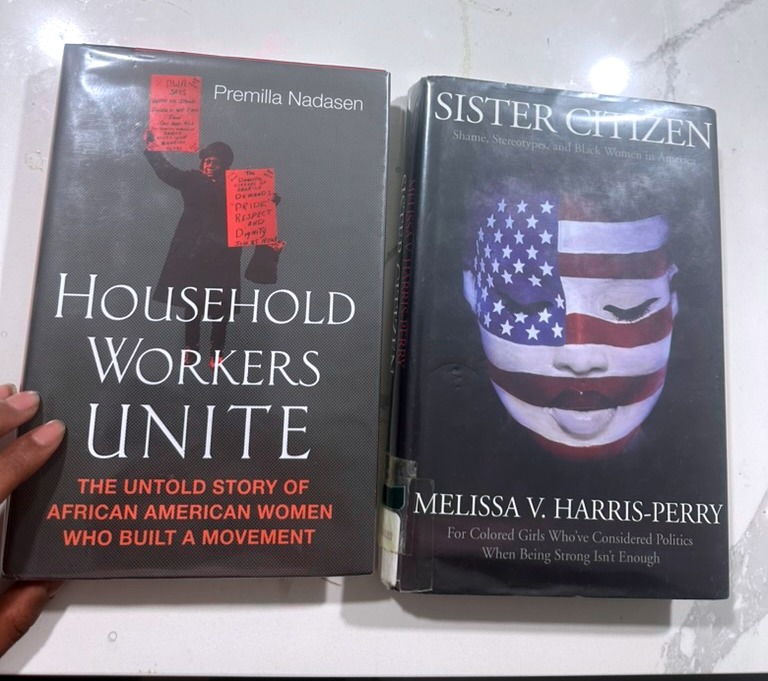
Love y’all. Mean it. If you love me back, Buy Me A Book!
-B
Further Reading
 Bethany Nicole
 Bethany Nicole
 Bethany Nicole
Collins, Patricia. Black Feminist Thought. 2009. Katie Geneva Cannon also talks about this at length. The idea in brief, is that Black women are the carriers of Black culture, and as such, collectively express the boundaries of acceptable moral behavior through child rearing, story telling, music (hymns, blues and hip-hop) and other experiential avenues. Cannon refers to this dialectic relationship w collective self actualization as navigating the land of “counterpain”. ↩




Member discussion