black girls BEEN liked anime
Growing up, I deliberately avoided Naruto.
Not because I didn’t like anime. I did. I loved Dragon Ball Z, Rurouni Kenshin, and YuYu Hakusho. My friend Rashida and I used to record Inuyasha onto VHS tapes after school. But in the early 2000s, being an “anime girl” carried a social stigma I wasn’t willing to own. I talked instead about Degrassi or My Wife and Kids, shows that felt “safe.”
By the time Naruto took off, the social math around anime was complicated. Boys would turn communal fandom into a pissing contest: you had to be able to sing the theme songs in both Japanese and English, memorize every episode’s release date and every character’s blood type. Even if you met their criteria, you still weren’t “enough.” By 2015, liking anime marked you as a “pick-me.” All I wanted was to be left alone to see who won the Death Tournament. It was too much work to keep having that silly conversation. Goku would never. Yusuke either. So I watched Toonami with my sister and kept my opinions to myself.
But I’m grown now, and I don’t have anything to prove, so I can say this w my full chest:
Black girls BEEN liked anime. Anime is the shit.
I only binged Naruto in full a couple of years ago. The timing was strange—but maybe not. I was already knee-deep in Soulwork. Already peeling back old myths and learning what it means to come home to yourself. So when I started the series, I was watching for more than plot. I was watching for metaphor. And baby, did I find it in the concept of the genjutsu.
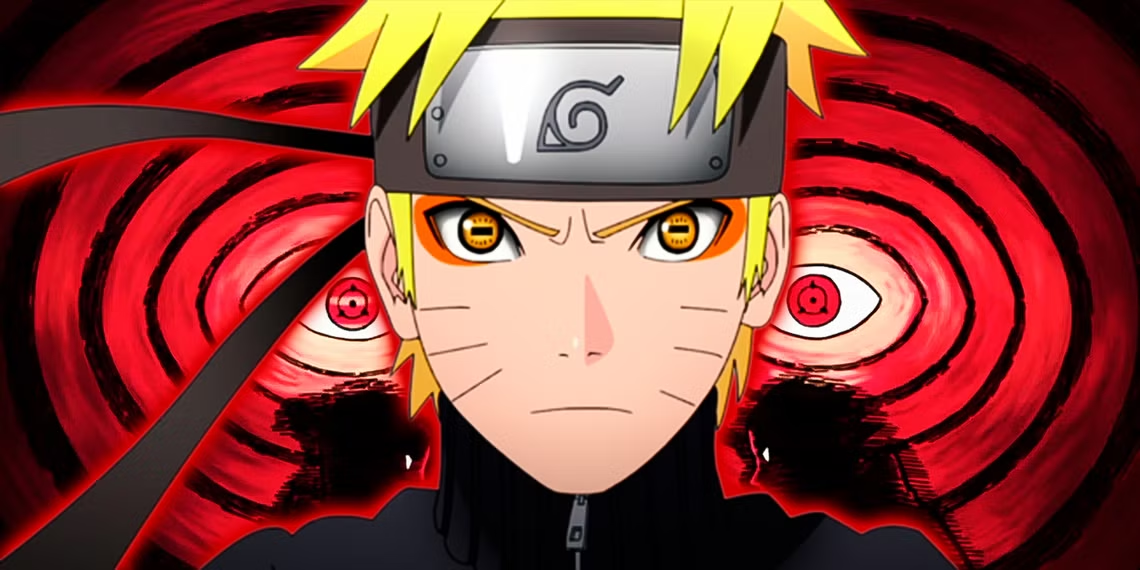
In Naruto, genjutsu is a fighting style that manipulates perception. A ninja slams their chakra into yours, hijacking your senses. Suddenly, they control what you see, what you hear, even what you feel. And masters like Itachi Uchiha who possesses the legendary power of the Sharingan eyes can implement genjutsus with scary precision.
At one point in the story, villains Madara and Kaguya take genjutsu global. They literally use the moon like a giant projector screen, beaming an illusion across the whole planet. Their goal is to trap all of humanity in a “peaceful” dream. No more war, no more suffering. Just perpetual, imposed peace…. It plays like an advanced police state.
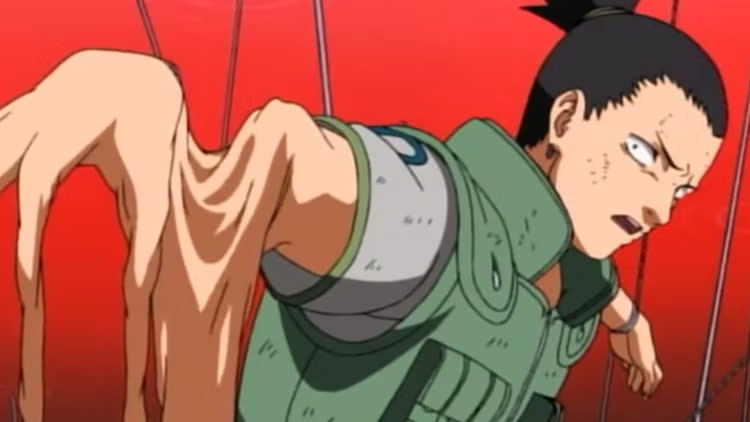
And that’s when it clicked for me. This whole moon-genjutsu thing felt a lot like America. It’s the crooked room Melissa Harris-Perry talks about cranked up to a cosmic level. Like I’ve said before, Black women (and honestly, so many of us MaGes read as women) live inside this distorted space. The room’s crooked because society keeps projecting these fucked-up illusions onto us, warping how we see even ourselves.
You know the classics: the Mammy sterotype makes us believe caregiving is our whole purpose, but whispers it’s never our turn to be cared for. The Jezebel trope turns our own skin and bodies into something we gotta apologize for. And Sapphire twists our truth-telling into “attitude,” turns our pain into some loud performance instead of something sacred.
This is society’s genjutsu, illusions injected into the air we breathe. They manifest in institutions, policies, pulpits, HR departments, dating apps, and our own mirrors, inflicting real harm.
I have lived under that kind of spell.
This is the spiritual violence of the crooked room. This is how genjutsu works.
In Naruto, when a ninja realizes they are caught in genjutsu, they can release themselves using a chakra disruption technique called kai. Failing that, a jolt of pain or an outside intervention can help them wake up. In my own life, the wake-up looks different. But the function is the same.
The genjutsu loosens its grip the moment I recognize it for what it is. Naming has always been powerful. It turns fog into form. Form into something I can move around—or through.
But naming the illusion isn’t enough. I also have to name myself.
That’s the deeper work: self-definition. To name myself is to claim my own moral authority. It’s to decide for myself what uprightness looks like. What tenderness sounds like. What freedom feels like in practice. It’s to unlearn what I was told, and to believe what I know.
The genjutsu never fully disappears. It waits. For loneliness. For fatigue. For silence. But now, I know what it feels like. And now, I know how to respond.
Even that old thought—Naruto is for suckers—was a kind of genjutsu. So was the myth that Black girls don’t like anime. So is the idea that anything we love must be for someone else’s gaze. That’s how deep the illusion runs. America itself can function like that—shaping what we believe is worthy, respectable, real.
But do what you want. Like what you like. That’s the point. The crooked room isn’t always physical—it can live in your own mind. That’s what makes the naming matter.
What I know now is that the world is full of illusions. But I am not one of them. My soul is real. My softness is real. My people are real. And so is the love that holds me steady when the room tilts.
Love y’all. Mean it. If you love me back, Buy Me A Book!




Member discussion